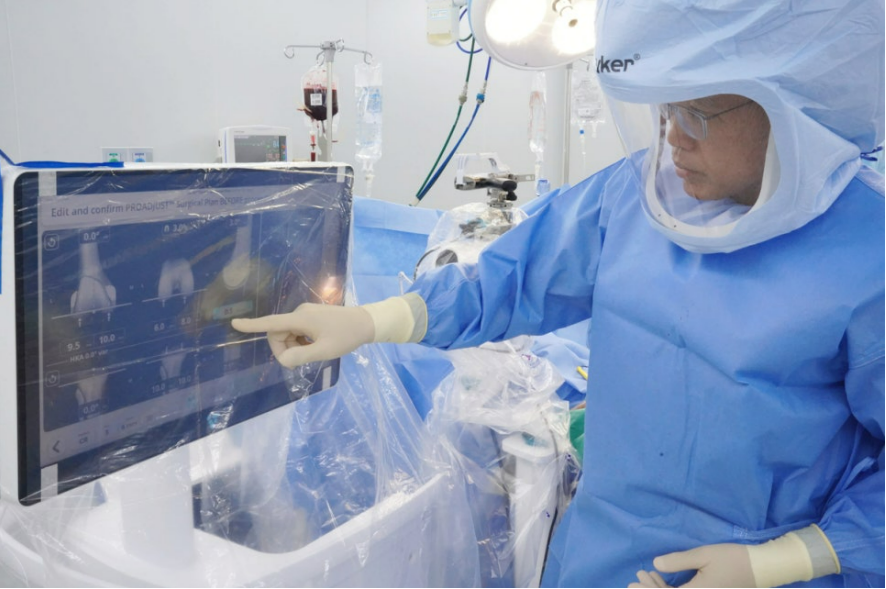
Ultra-Precision Robotic Knee Replacement Surgery & Core Medical Technologies
Knee replacement surgery (Total Knee Replacement, TKR) is performed over 100,000 times annually in South Korea, making it one of the most common orthopedic procedures. In recent years, robotic-assisted surgery has grown rapidly thanks to advancements in medical technology — and Wellton Hospital is at the forefront of this evolution.
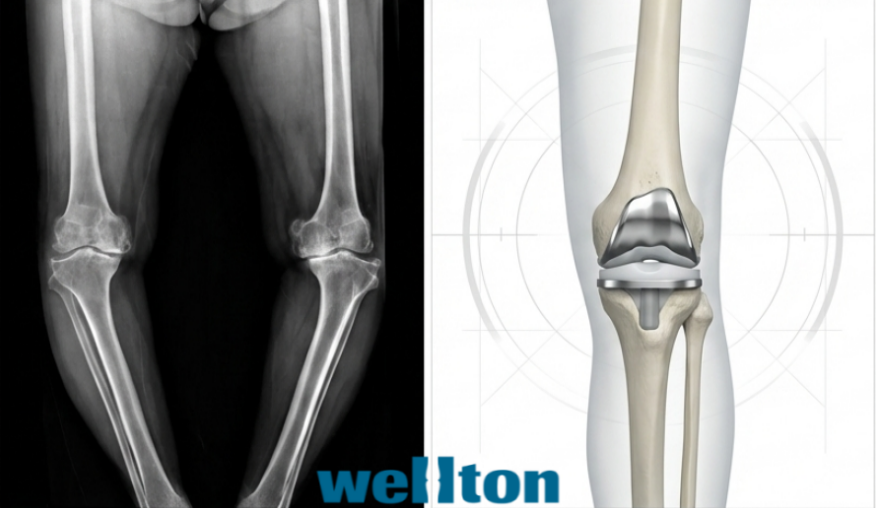
Wellton Hospital performs Minimally Invasive Robotic TKR (MIS Robot TKR) — completed through a single, minimal incision — offering patients optimal outcomes with faster recovery and fewer complications.
🤖 Advanced Robotic Technology: VELYS System
Wellton Hospital uses the VELYS Robotic-Assisted Solution developed by Johnson & Johnson, a world-class medical technology company. Designed specifically for knee joint surgery, this system delivers precision that leaves zero room for error.

⚖️ Perfect Knee Balance: Preventing Complications
One of the most critical factors in a successful knee replacement is achieving the correct balance across the joint.
Not only is left-right alignment corrected to prevent O-leg or X-leg deformity — the system also perfectly matches flexion and extension balance, ensuring natural movement after surgery.
Before any bone is cut, the robot checks ligament tension in real time and simulates the optimal resection plan. This prevents post-operative stiffness or joint instability before it can occur.
🏥 Wellton Hospital's 3 Core Technologies for Faster Recovery
When cutting-edge robotics is paired with Wellton Hospital's proprietary surgical expertise, patients return to daily life significantly sooner.
Rather than cutting through the quadriceps (the key muscle at the front of the thigh), the surgeon gently moves the muscle aside to access the joint — preserving its full integrity.
Since the most important muscle for walking and extending the knee remains intact, patients can stand and walk on the day of surgery — dramatically shortening overall rehabilitation time.
The posterior cruciate ligament — one of the key stabilizers of the knee — is retained rather than removed during the procedure.
Patients experience less of a "foreign body" sensation from the implant, and enjoy notably more stable, natural movement when going up and down stairs.
Conventional robotic TKR requires additional skin incisions to fix sensor pins to the bone. At Wellton Hospital, pins are secured through the original surgical incision — no extra cuts needed.

No additional scarring. More importantly, the risk of femoral fracture from forceful pin insertion above the knee is completely eliminated — making this technique safe even for patients with osteoporosis.
A single minimal incision. Muscle and ligament preservation. Robotic accuracy and safety.
MIS Robotic TKR at Wellton Hospital — less pain, faster recovery, and a healthier return to everyday life.