카테고리 spital 2026. 5. 9. 12:19

The Birth of Modern Hip Replacement
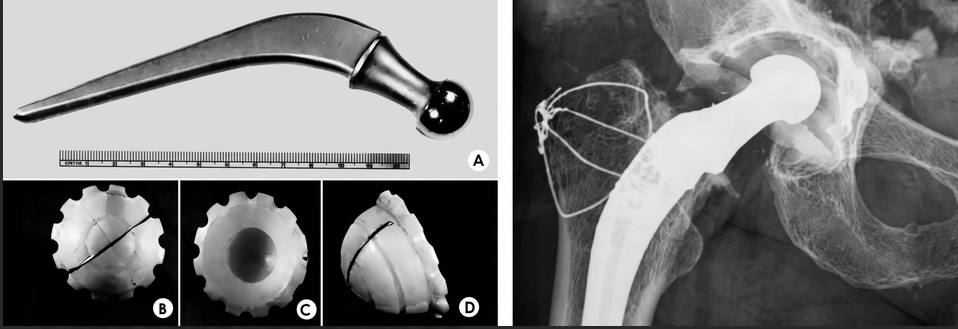
The story of modern joint replacement begins with the hip. In the 1950s and 1960s, British orthopedic surgeon Sir John Charnley pioneered a revolutionary approach: combining a metal femoral head with a plastic socket and securing the construct to bone using bone cement (PMMA). This breakthrough laid the foundation for everything we know today as successful, functional joint replacement surgery.
Sir Charnley's work didn't just solve a medical problem — it redefined what was possible in orthopedics and set the standard that surgeons worldwide continue to build upon.
The Ultimate Goal of Hip Arthroplasty Today
Modern total hip arthroplasty (THA) has evolved far beyond simple pain relief. Today, the true measure of a successful hip replacement is how quickly and safely a patient can return to normal daily life — walking freely, climbing stairs, and enjoying activities without restriction.

At Wellton Hospital, this philosophy drives every hip replacement procedure we perform.
The EXETER Hip Implant: Decades of Proven Excellence
Developed in the United Kingdom and manufactured by Stryker, the EXETER cemented hip stem is synonymous with long-term reliability. Its excellence has been validated through decades of clinical follow-up and registry data spanning multiple countries. The EXETER system's defining strengths lie in its bone-level stability and its genuinely patient-centered engineering.
①Immediate Stability & Precise Alignment
As the world's most trusted cemented implant, the EXETER stem provides powerful fixation through bone cement, allowing patients to bear full weight immediately after surgery. The Centralizer at the tip precisely positions the implant at the center of the femoral canal, eliminating thigh pain that can arise from implant-bone impingement.
②Unmatched Size Customization
The EXETER V40 stem is widely recognized for offering an exceptionally broad range of sizes — far surpassing other implant systems. Offset options alone range from 30mm to 56mm (30, 33, 35.5, 37.5, 44, 50, 56mm). Combined with stem body size, length variants (standard, short, long revision), and neck length (−4mm to +8mm), the modular system encompasses dozens of combinations — enabling surgeons to restore a patient's original leg length and joint geometry with near-perfect accuracy.
③The Taper-Slip Principle: Science That Gets Stronger Over Time
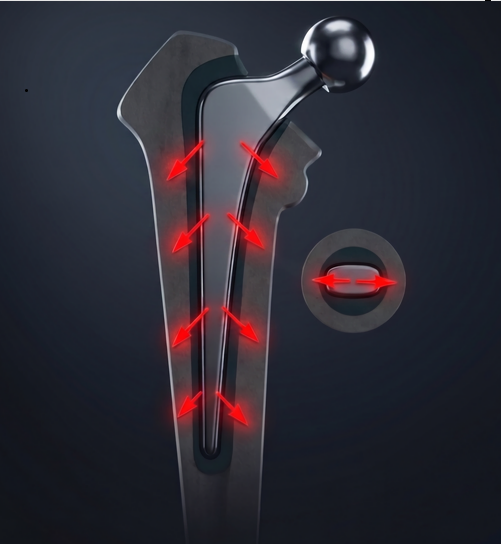
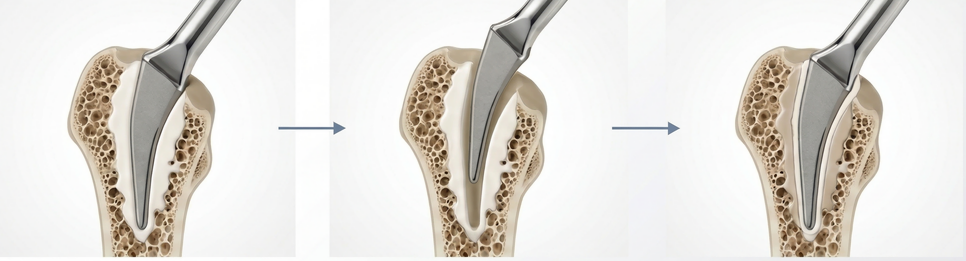
The Taper-Slip mechanism is the biomechanical innovation behind the EXETER's half-century of global prominence. Rather than being rigidly forced into bone, the wedge-shaped stem distributes load — and the more weight placed on it, the more tightly it locks into the cement mantle.
This is not a simple mechanical fix — it is an implant that works with the body's own biology to maintain healthy bone and continuously strengthen its own fixation over time.
④Optimized for Revision Surgery
The EXETER's true "patient-first" design extends to future-proofing. The Taper-Slip design allows for significantly easier stem removal when revision surgery becomes necessary — particularly important for Impaction Bone Grafting, a globally used technique for severe bone loss for which the EXETER stem is the gold standard. Because the metal never bonds directly to bone, the stem can be safely removed by releasing the taper-wedge interface, leaving the patient's remaining bone fully intac

External Rotator Preservation: The Key to Dislocation-Free Recovery
This surgical technique goes far beyond simply "cutting less muscle." It is the critical factor that determines a patient's quality of life after hip replacement.
The hip is the body's largest joint — a ball-and-socket construct where the spherical femoral head sits within the cup-shaped acetabulum of the pelvis. The anatomical barrier preventing dislocation is a group of short muscles wrapping the back of the hip: the Short External Rotators (SER). These muscles hold the joint firmly in place and rotate the leg outward.
In traditional posterior-approach hip surgery, surgeons were required to cut through these external rotator muscles to gain visibility for implant placement. While muscles are reattached after surgery, they never fully regain their original tension and strength.
The consequence: even a technically flawless implant can leave the joint mechanically unstable. Patients remain at risk of posterior dislocation — the femoral head slipping out of the socket — during everyday movements like crossing legs, squatting, or sitting in low chairs.
Wellton Hospital's Commitment to Continuous Excellence
The combination of the EXETER implant and external rotator preservation technique represents more than the sum of its parts. Together, they form a complete protocol for hip replacement surgery — one that minimizes pain, eliminates dislocation risk, and enables the fastest possible return to unrestricted daily life.
At Wellton Hospital, we remain committed to advancing this approach through ongoing research and clinical refinement. Our goal is not just to replace a joint — it is to restore a life.